How to Invest in Gold and Silver
What You Need to Know to Get Started
 |
Ryan Denby
Chief Operations Officer |
As Gold is rising back toward the record high off $1,800, we were reminded of just how far we've come from March of 2001 when Gold bottomed out at $258. It was a time of financial turmoil when Great Britain was forced to dump the nation's remaining Gold reserves on the market at depressed prices. Amazingly, from that time till now, the price of Gold has multiplied in value five times. Silver has likewise multiplied in value six times. It's been a great decade since then for anyone investing in precious metals.
Back then, critics said Gold was a relic of a by-gone era. Still, we vigorously defended precious metals as prudent and wise investments. We showed evidence as to why we believed Gold and Silver were still necessary to both the world banking system and individual savings. We argued then that Gold and Silver had a time honored role in the monetary system and deserved a place in everyone's portfolio.
Unique Benefits of Gold and Silver
1. Precious metals serve as a safe haven against a stock market crash or a bond market meltdown.
2. Metals protect against a falling U.S. Dollar that could wipe out your savings.
3. Gold and Silver are the best hedges against inflation.
4. Finally, they are the ultimate insurance against an unimaginable financial disaster.
Unfortunately, since 2001 we've had three of these scenarios wreak havoc on investment portfolios. (More than likely, inflation will be next.) Americans have watched helplessly as $14 Trillion Dollars of their wealth was destroyed. The markets have recovered some of those harsh losses, but it's certainly no wonder why Gold and Silver have skyrocketed in value. There's no denying that a core holding of precious metals (and certain types of U.S. Rare Coins) have proven their value as portfolio insurance and sound money in the face of a near economic collapse of 2008-2009, a recession that was second in severity only to the Great Depression.
A Bleak Economic Outlook
As we look ahead, America continues to face extreme financial challenges, unemployment at historic highs, a falling U.S. Dollar, Government debt at unprecedented levels, and an out of control Congress. We've watched the Federal Reserve double the money supply– and more. Yet, the country faces the threat of a severe "double-dip" recession and massive deficits once Government bailouts and stimulus spending ends.
What has been left for wealthy Americans is an uncertain future in which cash in the bank pays virtually no interest. The Stock Markets will continue to be risky and volatile. Bonds face the worst nightmare scenario of all, if inflation spins out of control– as we believe it will. In times like these, we feel owning physical Gold and Silver is an absolute MUST for wealth preservation. As we look ahead, if demand continues at current levels, precious metals are sure to be among the most profitable investments again over the next 5 years.
Before You Invest A Dime
But, before we share the details, we first want to share our philosophy of of fine tuning and implementing a precious metals' plan. The Gold Information Network, the gold division of Austin Rare Coins, Inc. has served investors and collectors for over 23 years now. In that time, we've developed a detailed, common-sense approach to buying and holding Gold, Silver, and U.S. Rare Coins.

We call it "The Austin Three Tier Plan" to investing in precious metals. This is a proven approach that's worked very well for our clients over the past 10 years.
1. Gold – Everyone should start with a solid foundation of Gold Bullion.
2. Silver – We then add Silver Bullion and Silver Dollars for diversification and exposure to the roaring Silver Markets.
3. Pre-1933 Gold – Finally at the top of our pyramid we add a few Pre-1933 U.S. Gold Coins and classic Silver Dollars as your budget permits.
Why would we share our philosophy online where any client or competitor can read it? Because the success of The Austin Three Tier Plan is dependent on a team of Gold and Silver Specialists and Austin Buying Trust to fine tune the plan to fit your individual needs and goals.
We feel this is the most important service we can provide to our clients: Sharing our knowledge and experiences with investors just getting started.
We know your long-term success will depend on having professionals you can trust working alongside you, to guide you, and to advise you every step of the way– until the time you're ready to sell.
First and Foremost: Choose a Reputable Firm
Identifying the right firm to assist you in realizing your individual goals is vital to your success. There are many "pretend" metals dealers on the internet these days. The precious metals industry is unregulated. Unlike the stock market, where brokers need to be licensed to sell equities, anyone can go into business on the internet or sell coins on Ebay.
More than ever before, it's crucial to determine the experience and reputation of your Gold dealer first. The firm you work with must be trustworthy, have solid credentials, and be respected in the marketplace by the clients it serves.
A firm's success is reflected in how long they've been in business and their reputation with the Better Business Bureau. In our case, you will see an A+ rating. Some of the largest bullion firms in the country that you hear on the radio have an F rating at the BBB for overcharging, poor delivery, and dissatisfied clients.
"We can proudly state that Gold Information Network a division of Austin Rare Coins, Inc has never had one outstanding complaint with the Better Business Bureau over the past 23 years."
This perfect record includes clients of the website you are currently visiting, the Gold Information Network– as well as the Austin Coin Collecting Society and Austin Rare Coins & Bullion that specializes in U.S. rare coins.
Another indication of a firm's reliability is their connections to self-policing industry groups like the American Numismatic Association, PCGS, NGC, and ICTA. Austin Rare Coins, Inc. is a member in good standing with these and a number of other rare coin associations.
Ask for References
We also suggest you ask any firm for professional references and call the contacts listed. Make sure the company is real.
You can most often measure the professionalism of a company by the content of their website, like the report you are reading. We have over 1,000 pages of free information online covering the history of rare coins, advice on buying Gold, Silver Profit updates, exclusive Austin Reports, and detailed coin descriptions to guide our clients with the knowledge they need to make good decisions. These can be found on Austin Rare Coins, the Gold Information Network, and the Austin Coin Collecting Society.
You Deserve Personalized Service
We have learned over our 23 year history that each client is unique. Goals, objectives, time frames, and interests are different from individual to individual. Some of our clients will buy only a few coins in their lifetime.
"At the other extreme, we've been blessed to build many million-dollar rare coin collections
for our clients and later liquidate them when they were ready to sell."
Affluent clients expect and deserve the highest level of professionalism– and they receive it from the Gold Information team. We're happy to help each client, step by step, through the process of education, making the first purchase, and through the holding period. We'll stay in touch and will be here any time when you're ready to sell. Regardless of the budget size, we believe every client deserves highly personalized attention. Our staff is always here, and we can help when you call.
Here's a tip on what you should expect from a real professional: Were you asked what you are trying to accomplish? It's important that a dealer has a crystal clear idea of what you are trying to do now– and in the future. Many of the goals we're hearing these days range from “safety” or “barter for an emergency” along with “wealth preservation” or “long-term growth."
Depending on your answers, an experienced professional can help you make the best choices for your individual situation. Different goals would lead us to recommend a different mix of precious metals. Only by asking about your goals and expectations, can we fine tune the Three Tier Plan to fit your needs.
THE BASICS OF INVESTING IN GOLD AND SILVER
As this "How-To" guide continues, we'll share with you a vertical strategy for buying Gold, Silver, and U.S. Rare Coins. We'll briefly show you the benefits and profit opportunities we see in each unique segment of the market.
Always Start With Bullion
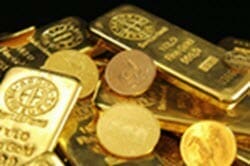
Most people hear the term "Bullion" and think of giant Gold bars from the movies. In fact, bullion refers to a coin or bar that trades near the price of its respective metal and will go up, or down, with the market price of that metal each day. We typically offer 1 ounce Gold Bars but they do come in a range of sizes.
Most Gold and Silver prices are quoted in the cost for one troy ounce. Modern Gold Coins are bought and sold in One-Ounce increments with some in half, quarter, tenth-ounce weights. The most popular forms of modern Gold Bullion today are shown to the left. Silver is often traded in One-Ounce Coins or Ten-Ounce and 100-Ounce Silver Bars.
You should be able to acquire most of these items for 10% or less over the prevailing "spot price." It's not possible
, even for a huge dealer, to buy tradable Gold at the spot price you see in the paper or on CNBC. This price refers to futures pricing or is a quote for a 1,000 ounce Gold Bar for delivery in London. (This is the wholesale cost of Gold used in manufacturing or jewelry, not for finished Gold coins or bars.)
The premiums you pay over the "wholesale price" includes what the mint charges to convert a huge 1,000 ounce bar into 1,000 small coins plus shipping, handling, and distribution fees. In most cases, a portion of those can be recovered at the time you sell.
Silver is Undervalued and Often Overlooked
We believe Silver will continue to outperform Gold as the bull market continues.
For Silver, the most popular item is the Silver American Eagle followed by the Canadian Maple Leaf coin. Premiums on these items have risen in recent years due to the overwhelming demand and diminishing supplies. There was a two month stretch in the latter part of 2008 when we couldn't acquire silver bullion coins in any capacity.
This gives us incredible conviction in recommending silver ownership to our client base. It's simple supply and demand fundamentals - supplies were wiped out in a matter of days.
Other popular Silver items are the 100 ounce bars or the 1 ounce rounds, which are privately minted at respected refineries. These often trade at a lower cost-per-ounce than the Silver Eagles or Maple Leafs.
Based on our recommendations, thousands of our clients have doubled their money in recent years holding Silver. Those who were with us since the low in Silver prices back in 2001, have multiplied their money in Silver over five fold.
One interesting note– Premiums charged over the value of the Silver alone will rise and fall on newly minted, modern Silver Dollars. There was a two month stretch in late 2008 when the overwhelming demand for Silver outstripped the supply. Dealers could not find enough Silver Coins from the U.S. Mint or World Mints to meet the demand. Premiums over their Silver value alone rose dramatically. Thankfully, premiums have normalized.
Our point is that the explosion in Silver premiums gives us strong conviction to recommend Silver ownership due to the short supply, high demand fundamentals.
Silver investments are also traded in 100-Ounce Bars or One-Ounce Rounds. These are privately minted at respected refiners and trade at a lower cost-per-ounce than Silver Eagles or Maple Leafs. At times, they offer a great value in the current marketplace given their low premiums.
Buy Bullion for Security
We like to think of these Gold and Silver Bullion holdings as the foundation our clients should build upon first. They usually move opposite the U.S. Dollar and other paper currencies. As inflation eventually takes hold, we expect the value of these metals to increase dramatically. In times of financial crisis and hyperinflation, Gold and Silver have proven to be reliable stores of value since they rise in price as the paper currency loses buying power.
Then there's a little known, sometimes misunderstood area of Gold investing that you need to know about.
Pre-1933 U.S. Gold Coins
First time Gold buyers will be looking at this heading and asking, "What are Pre-1933 U.S. Gold Coins and why should I own them?"
Those are excellent questions! The bullion foundation of our Austin Three Tier Plan offers you the utmost in safety and security. You should buy bullion first– an adequate amount of Gold– and then Silver. In addition, we recommend a special kind of very affordable Pre-1933 Gold Coins.
Common Date Gold Offers Special Benefits
1. Diversification - Pre 1933 U.S. Gold Coins can diversify your holdings.
2. Leverage – Rising along with Gold, they also provide leverage to the Gold market enjoying both investor and collector demand.
3. Not Subject to Confiscation – Only a few months ago, few of us could imagine the Federal Government seizing our private assets. Today, adding Pre-1933 Numismatic Rare Coins will provide you with the added safety of owning Gold that, by law, is exempt from U.S. Government confiscation.
Gold and Silver's Long History As Money
To better understand the long-standing relationship of Gold and Silver to money, we need to share a bit of history. When the founders of the United States formed the nation, they very clearly defined that "only Gold and Silver could be used as money." So from 1776 on, real Gold & Silver Coins was used as money.
After the 1929 Wall Street Crash, the banking system had failed, Stocks eventually lost 80% of their peak value, businesses went bust, and unemployment soared. To re-inflate the economy, President Franklin Roosevelt and his Democrat controlled Congress went on a wild spending spree. (Does this sound familiar?)
Gold Recalled from Americans in 1933
The year 1933 is a key date during the Great Depression, a date that changed the destiny of American money. This was the year the U.S. Government recalled all Gold Coins from its citizens and ceased minting Gold Coins.
The decree made it unlawful to own or hold Gold Coins, Gold Bullion, or Gold Certificates which previously could be exchanged for Gold at any bank.
Shortly after seizing the Gold money belonging to individuals, The Treasury issued new paper dollars. The value of Gold was raised 69% from $20.67 an ounce to $35.00. What this did was instantly devalue the buying power of the new paper currency, thereby transferring a huge portion of the nation's wealth from individual control to the Government's control.
A Brief History of Gold As Money
The first U.S. Gold Coins were minted in 1795. From then until 1933, Gold Coins were issued by the U.S. Mint as official legal tender money.
Starting in 1849 designs on coins were changed and many of the popular U.S. Rare Coins we know today began to be minted. The largest Gold Coin of this era was a Double Eagle, often called a $20 Gold Piece. This is an example of a $20 Liberty which contains just about an ounce of Gold (.96750 troy oz.).
Next was the Eagle $10, about one-half ounce, then the Half-Eagle $5 (a quarter-ounce) and the Quarter Eagle $2½ (with approximately an eighth of an ounce of Gold). Many dates were originally struck in relatively large numbers.
Over the decades, most of the Pre-1933 Gold Coins went into circulation where they were worn down, lost, returned to the U.S. Mint, or destroyed during the great gold meltdowns that occurred after the U.S. Government recalled Gold. As a result, only a small percentage of the original coins have survived at all, much less in high quality, grades suitable for investments.
Only those Gold Coins held outside the country, illegally in private hands, or that were exempt as "rare, numismatic coins with special collector value" have survived.
"Common Date 1933 Gold" vs. "Rare Coins"
In this section of the Austin Three Tier Plan, we focus on the top tier which includes truly Rare Coins and "Common Date" Pre-1933 Gold.
So what exactly is a “Common Date” Gold Coin? In the Rare Coin Market, there are ‘scarce’ coins and there are fundamentally RARE Coins.
An example of a fundamentally Rare Coin is an 1859 New Orleans $10 Gold piece. Only 2,300 were struck and fewer than 60 are known to exist and have been certified by PCGS and NGC over the past 25 years. Today, the finest known in the series would sell in excess of $70,000– but you could never get the present owner to sell. (We know, we sold him the coin.) Yes, this is an extremely rare coin and perhaps a price tag that scares away some people. Coin dealers refer to this as a "Classic Rarity"— a coin that is fundamentally rare in all regards and beyond the price range of most collectors.
You'll be happy to learn that there are old U.S. Gold Coins that are "less rare" and very affordable. One example is a Pre-1933 "Common Date" Gold Coin. This coin is common within the series, with a higher surviving number. They can be quite affordable, even those preserved in Brilliant Uncirculated, Mint State grades.
For example, let's take the 1932 $10 Indian with a mintage of over four million coins. The majority of these don’t exist today. However, there are well under 30,000 examples of this date that grade MS-63. This is a nice "Mint State" coin that usually has great eye appeal and is in high demand among coin collectors.
These are not fundamentally rare, but relatively scarce– and very affordable trading around $1,800 each. These coins have a "Double Profit Opportunity" as they usually increase in value with Gold and their premiums over gold can rise quickly in a hot coin market.
Limited Supply, Scarcity, and Condition
The benefit of Common Date Gold is that no more will be minted ever. All that exists today is all there will ever be– collectors and investors will always be in the market for affordable coins like this. In addition, there's a fixed and limited supply which makes them extremely sensitive to supply and demand fundamentals.
There are other factors too that can affect the value. We call this “Numismatic Value”— a term which refers to the relative scarcity and condition of a particular item.
In the 1980's, the Rare Coin Market took off when grading services were established to standardize the grading. They then recorded the number of coins known to exist of each denomination, mint, and grade. At last, Rare Coins could be traded sight-unseen on a fair playing field in which investors could enter the market to buy and sell coins.
Today, certified coins are graded by either PCGS (Professional Coin Grading Service) or NGC (Numismatic Guaranty Corporation). These are trusted as the most independent and reliable firms in the industry which helps to establish consistency and liquidity.
COIN GRADING SCALE
Highest Grades
Perfect Uncirculated Mint State 70
Gem Uncirculated MS-69
Gem Uncirculated MS-68
Gem Uncirculated MS-67
Gem Uncirculated MS-66
Collector/Investor Grades
Choice Uncirculated MS-65
Choice Uncirculated MS-64
Uncirculated MS-63
Uncirculated MS-62
Uncirculated MS-61
Uncirculated MS-60
Circulated Grades
Choice About Uncirculated AU-58
About Uncirculated AU-55
About Uncirculated AU-53
About Uncirculated AU-50
Extra Fine XF-45
Extra Fine XF-40
Lowest Collector Grades
Very Fine/Extra Fine XF-35
Choice Very Fine VF-30
Very Fine VF-25
XF-20
Fine F-12
Very Good VG-8
About Good AG-3
Barely Recognizable 1 |
|
The grading services keep track of all the coins they grade in population reports. We can actually see just how rare a coin is by looking at how many of that particular coin the grading services have certified over the past 25 years. These “pop reports” can give you a very good understanding of a coin's rarity or can help in locating undervalued areas of the market.
The Sheldon Coin Grading Scale
The "Grade" of a coin is opinion, expressed by experts, on the state of preservation of a coin. The fewer signs of wear or distracting scratches, the higher the grade. In most cases, the higher the grade, the fewer that exist and subsequently the higher the Rarity and the Value placed on the coin. The Rare Coin Industry grades coins using the “Sheldon Scale” which ranges from a "1" that's a barely recognizable coin up to a "70" for a flawless, perfect coin.
Coins in the highest 60 to 70 range are said to be in Brilliant Uncirculated "Mint State" condition. Coins in MS-65 and above are in Gem Brilliant Uncirculated condition.
We typically recommend Pre-1933 Common Dates in the MS-62 to MS-66 range for the best demand and liquidity. The reason is that anything under MS-62 tends to be too common, scratched, or has such poor eye appeal that investors or collectors don't get excited about them. We typically don't like them and don't recommend them– unless we find a group at a super low price. Anything over the grade of MS-66 is a terrific coin for experienced coin collectors but becomes too pricey or obscure for the majority of the investing public.
The specific coins, dates, and grades we recommend on a given day will depend on current availability, price, and the value of the coin, as we see it, compared to other Common Dates offered to us. Our Austin Buying Trust is constantly seeking out the best buys we can find– because that's where the best value lies.
We Search for Currently Undervalued Coins
We fully believe in the long-term benefits of owning Common Date, Pre-1933 Gold. Time and again we see the scarce supply of a specific series wiped out in a matter of days. A spike in demand forces dealers to bid up prices quickly when they sell out and need to fill existing orders or replenish inventories. Empty vaults generate no sales.
The Common Date area of the Pre-1933 Gold Coin Market offers leverage, what we've always called a "Double Profit Opportunity." At times, key areas of the market will be undervalued– and that's exactly where we find the most value for our clients.
As you can see, there's far more about the Gold, Silver, and Rare Coin Markets that we would love to share with you given more time or space. This report should suffice to show you what to avoid and to prove to you how expert advice pays off.
This is just one niche profit opportunity that should prove to you how our knowledge and experience makes the Gold Information Network the perfect place for you to get started. With Silver prices gaining six-fold since 2001, and Gold setting off all-time highs, our phones have been ringing off the wall. Sales have been soaring here on our Gold Information Network website.
There's no reason for you to miss the next leg up in the current Bull Market for precious metals. We hope we've provided enough facts and information to help you get started.
How to Invest in Gold and Silver Today
1. Call Us – We're here and we can help answer any questions you may have, take orders, lock-in prices, and explain paying by check or bank wires.
2. Buy Online – We accept orders online in our safe, secure shopping environment here at the Gold Information Network. You can use your credit card on orders up to $5,000.
3. Request Free Reports – As experts in the field, we are somewhat prolific in writing about Gold, Silver, and U.S. Rare Coins. We offer all our reports free of charge. You can click below for the latest updates.
We urge you to delay no longer in moving money into what has been the most profitable investment sector of the decade, precious metals. Call now at 1-800-668-8771 with any questions you may have. We're here to help from 9am till 9pm central time seven days a week.
Doing nothing at this key moment in history could prove to be an expensive mistake. Please take advantage of today's hot precious metals market, it may be the last one in our lifetimes.
Call a Gold Specialist at 1-800-668-8771 to get started today!